Care moves.
CareTech keeps the thread.
Every shift, every vital, every report — on one record that travels with the person. Across hospitals, homes, schools and diagnostic centers, CareTech puts each one in front of whoever acts next.
Care crosses buildings. The software usually does not.
Continuity is not a property of a building. It is a property of the record.
A discharge
Leaves hospital care
A home visit
Care at the kitchen table
A rehab course
Physical therapy milestones
A school nurse
Administration & alerts
A diagnostic panel
Specimens and lab reports
A follow-up
Clinical validation
A patient's year crosses buildings, professions and organizations: a discharge becomes a home visit, a rehab course, a school nurse's office, a diagnostic panel, a follow-up.
The setting changes. The professional changes. Underneath them the software changes too. That is where continuity is lost, and why the same questions get asked twice.
CareTech is built for the movement itself: the record, the workforce and the intelligence cross with the patient, on one connected system. What happens in a home is visible in a clinic, and what the data shows afterwards reaches the person who is allowed to act on it.
Three areas, one record. The alternative is three systems that disagree.
Every healthcare organization asks the same three questions: can we deliver care to someone who is not in the building, do we know who is cleared to work and when, and what does the data say afterwards? Twenty-seven products answer them on one backbone.
Connected Care & Remote Health
Care where the building is not.
Care that happens where the organization is not: a virtual consultation, a reading from a device at a kitchen table, a caregiver at a front door. The record goes with the patient, not with the building.
Healthcare Workforce & Operations
Who is cleared to work, and where.
Who is allowed to deliver care, where, and on what terms, from a clinician's first upload to the pay figure at the end of the shift. The rules are enforced at the gate, not audited after the fact.
Health Intelligence & Diagnostics
What the data says afterwards.
What the data says after care has happened, and who is qualified to act on it. Every product here ends at a person: the analysis arrives with the data it was drawn from, and a clinician confirms it.
Every handoff loses something. This one is built not to.
A person sits at the center; the settings, the touchpoints and one unbroken record orbit them. The record travels with the person, not with the building that produced it. And nothing becomes an action until a qualified person has decided, with the record in front of them.
An indicator is not a decision.
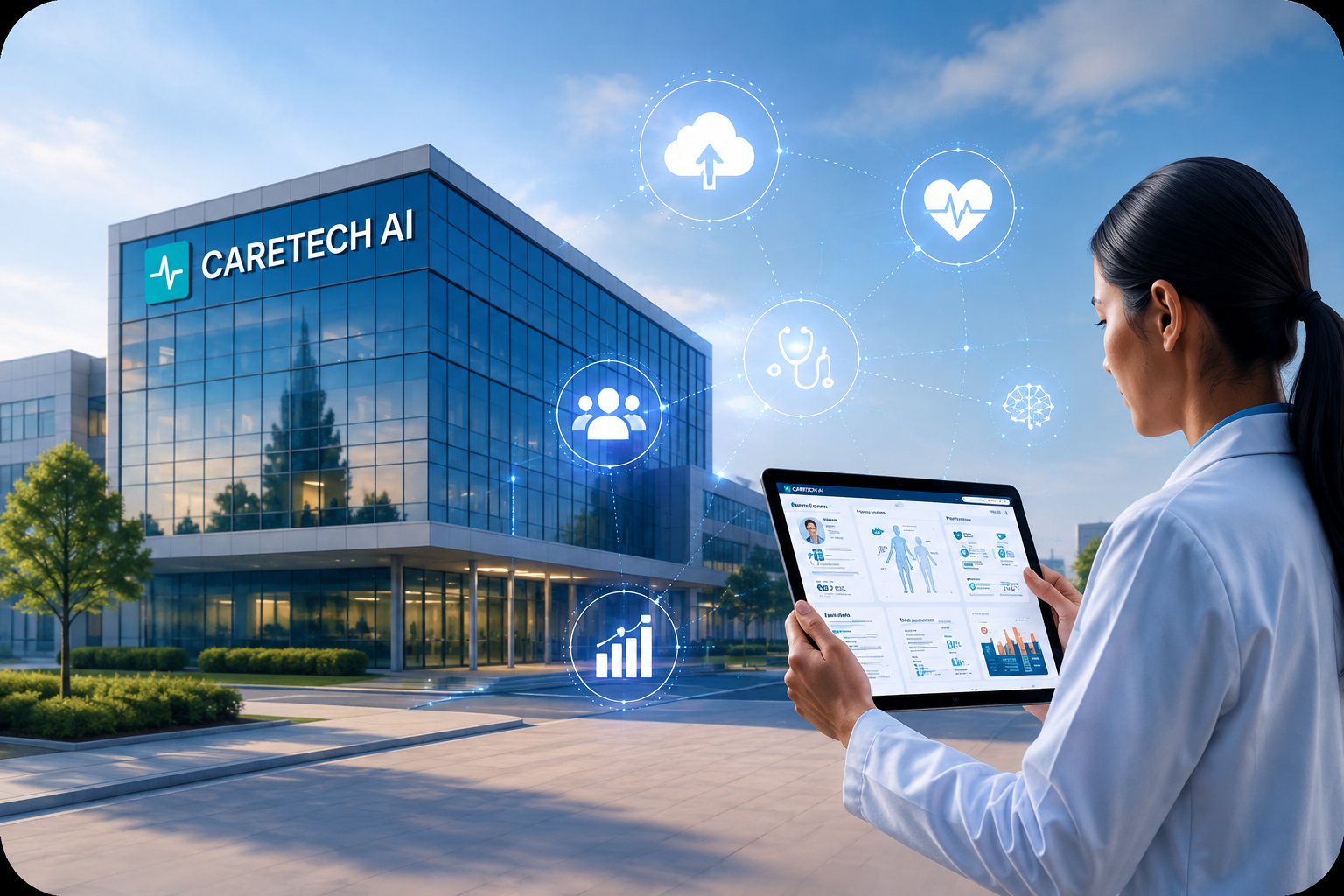
CareTech AI is intelligence in the workflow, not intelligence instead of a person. It reads what is already there, says what changed, and puts it in front of whoever is qualified to act. The deciding stays with them.
Key Capabilities
Identifies patterns
Across lab values, vitals, biomarkers and operational data that are hard to see one record at a time.
Connects context
Reads a value against the patient's own history, the reference range, the setting and the rest of the panel.
Prioritizes
Puts the case that needs attention first, because the scarce resource on the screen is a professional's attention.
Matches resources
Available, credentialed people to the work that needs them; care programs to the patients who qualify.
Organizes information
Turns documents, uploads, intake forms and free text into structured, searchable, routable records.
Tracks longitudinal signals
Follows a person's own series over months and years and surfaces the change, not just the reading.
Two moments from the platform. One of them is a refusal.
The platform's own vocabulary, exactly as it reads on the day.
The gate is the product.
A schedule that refuses the wrong answer
Discovery by role and readiness, availability-based matching, approval-led confirmation. And a refusal recorded with its reason, so the question can be answered months later.
A reading that reaches nobody is not monitoring.
A reading that reaches a person
It arrives from a connected device, is read against the patient's own trend, and routes to the care team that owns the patient.
Eleven care settings, and the staffing operations behind them.
A school nurse's office at 8:40. A night scheduler filling a shift. A radiologist whose report a patient will read next. The platform is arranged around whoever acts after the data arrives.
Hospitals
The unit coordinator covering a floor, and the discharge that becomes someone else's Monday morning.
Clinics & specialty care
The front desk that books, and the physician who reads the intake before the patient sits down.
Diagnostic centers
The technician tracking a specimen, and the radiologist whose report a patient will read next.
Home healthcare
The caregiver at the front door, documenting the visit where the visit actually happens.
Senior & assisted living
The night aide, the family three time zones away, and the same care plan in front of both.
Schools
The nurse with a queue at 8:40, a medication administration log, and a parent to call.
Correctional healthcare
The intake screening, and the provider assigned before the clinic list is made.
Behavioral health
The therapist holding continuity, and the coordinator who routes an escalation to a person.
Rehabilitation
The scheduler working across three therapy disciplines, and a milestone a family can see.
Post-acute care
The transition coordinator, and the medication list that has to survive the move home.
Longevity clinics
The physician and the coach reading the same baseline a year apart.
Staffing operations
The scheduler at 6am filling a night shift with someone who is actually cleared to work it.
Enforced by the database, not promised by the code.
Tenant Isolation & Security
Enforced strictly at the database schema layer rather than in application logic to guarantee isolation.
Traceable Audit Logs
Comprehensive system activity logging captures exactly who did what, and when, for full accountability.
Decisions Recorded Alongside Basis
A qualified professional decides, and the decision is recorded with the telemetry data visible alongside.
Regulatory Foundations
Designed strictly in view of HIPAA, HITECH Act, GDPR, India DPDP Act 2023, and state laws.
Show us where the thread breaks.
Bring the worst handoff you have. That is the demo.
One platform, one record: it holds telehealth networks, home care operations, school and correctional health programs, diagnostic chains and longevity clinics. Start with the one closest to your operation.